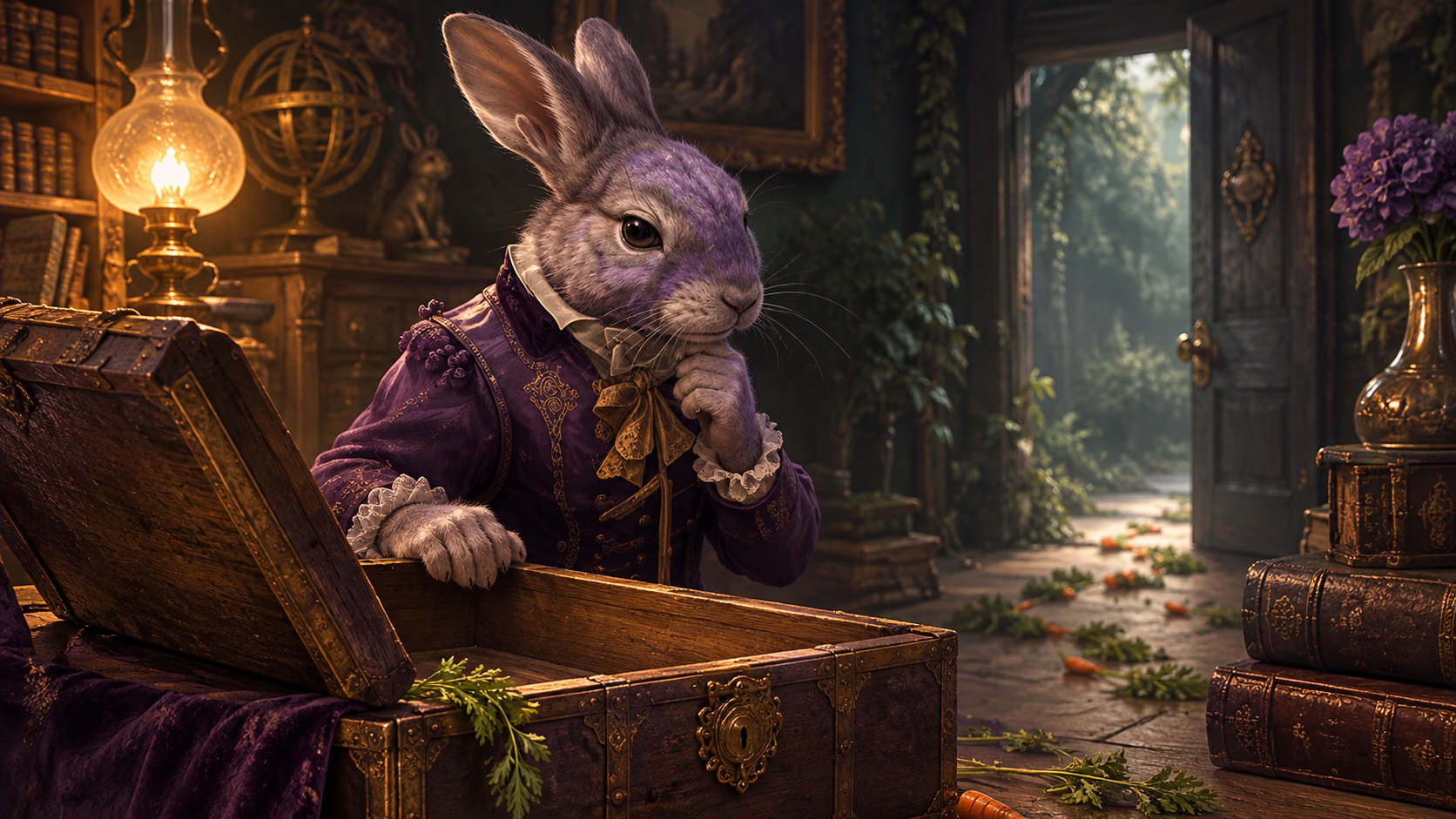
In Carrotville, Purple Rabbit considered himself a connoisseur of carrots. He grew them in neat rows, sorted them by size, and kept the finest specimens in a polished wooden cabinet. His neighbours paid him in carrots for jam, polishing, and the occasional very serious opinion about their hats.
“A carrot is honest money,” he often declared. “It is useful, portable, and improves soup. What more could one ask?”
One bright morning, he packed a dozen especially handsome carrots into his travel sack and set off for the neighbouring forest market. He had heard that its stalls sold remarkable things: acorn cakes, embroidered waistcoats, and a brass compass shaped like an owl. He arrived hungry and eager to shop.
The first stall belonged to a squirrel selling acorn cakes. Purple Rabbit offered two carrots. The squirrel shook her head. “We trade in acorns here.”
At the next stall, a hedgehog accepted neither carrots nor acorns, only copper buttons. A fox merchant would take carrots, but his exchange rate was so poor that Purple Rabbit would have had to surrender nearly his entire sack for one small coin.
“And there is a handling fee,” said the fox, holding out his paw.
“For handling what?” Purple Rabbit asked.
“The carrots.”
“You have not handled them yet.”
“The fee is for the possibility.”
Purple Rabbit clutched his sack. His money was perfectly good in Carrotville, yet here it could not easily buy lunch. Carrying more only made his shoulders ache. He sat beneath a chestnut tree, watching merchants exchange goods with practiced ease.
An owl in a blue waistcoat settled on a branch above him. “You seem troubled, young sir.”
“My carrots are excellent,” Purple Rabbit said. “The market is the difficulty.”
Professor Hoot listened while Purple Rabbit described the currencies, prices, and fees. Then he asked, “Have you ever wondered why money has to be something you physically carry?”
Purple Rabbit glanced at his enormous sack. “Honestly, my back has been asking the same question.”
Professor Hoot explained that money is a tool communities use to exchange value. A shared currency can make buying and selling simpler, but different communities may choose different forms of money. When someone trades directly, both sides must want what the other offers. Money helps avoid that awkward dance, though exchanging between currencies can still involve rates, costs, and rules.
Purple Rabbit looked again at the market. His carrots had not become worthless; they simply were not the currency these merchants used.
On the walk home, Professor Hoot mentioned that some money exists only in digital form.
Purple Rabbit’s ears sprang upright. “Digital carrots? Now you are talking!”
And for the first time, he wondered whether value could travel without a single carrot in his backpack.