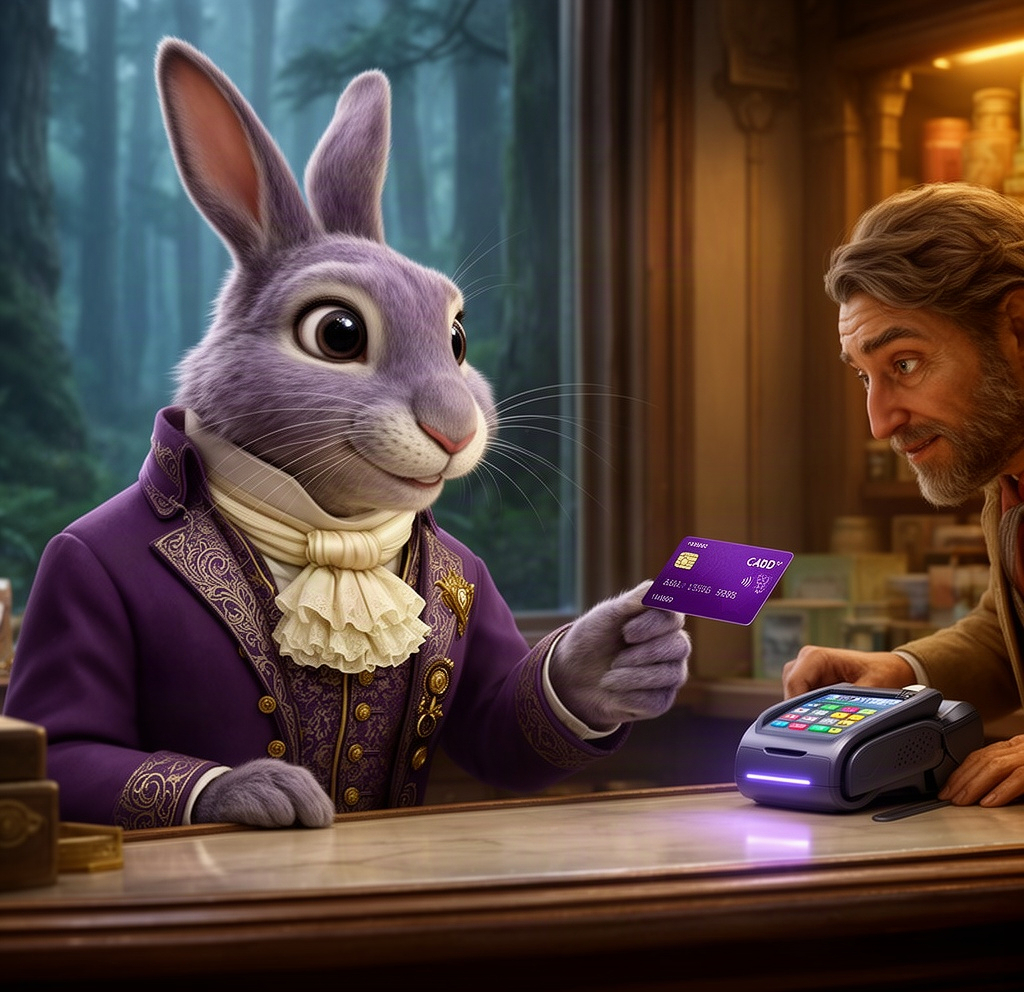
Purple Rabbit returned to Foxy’s shop with a sketchbook, three pencils, and a question. He had learned how digital assets could be transferred, but Foxy still wanted a familiar payment he could use to restock his bakery.
“We need a bridge,” Purple Rabbit announced, drawing a card with a golden carrot on it. “Something that connects digital assets to an ordinary purchase.”
Professor Hoot studied the sketch. “Some products called crypto-linked payment cards connect supported digital assets with a card payment network. The details vary. Depending on the provider, assets might be converted into ordinary currency when a transaction is made, or the product may work another way. We should not assume every card behaves alike.”
Purple Rabbit added a shining chip to his drawing. “Then the card is the bridge?”
“It is one piece of a much larger arrangement,” said Professor Hoot. “The card issuer, payment network, conversion service, and other providers may all have roles. A real product also needs technology, agreements, safeguards, and any required approvals.”
Foxy leaned over the counter. “Can I actually receive my payment?”
Purple Rabbit paused, pencil in the air. “Well... that is what we are going to figure out.”
The three of them staged a pretend purchase using counters and paper tokens. First, Foxy entered the price into a mock terminal. Next, a pretend issuer checked the request and whether the account could cover it. The request traveled through a paper chain marked CARD NETWORK. A conversion desk calculated an example exchange, including a clearly displayed fee. Finally, Foxy received a paper receipt showing what he would be paid in the shop’s familiar currency.
“So the customer may spend a supported asset,” Purple Rabbit said, “while the merchant receives an agreed settlement amount in a currency the merchant can use.”
“In some products and situations, yes,” Professor Hoot replied. “Authorization is not always the same as final settlement, and fees, timing, exchange rates, supported assets, and declined transactions depend on the product.”
Foxy inspected the receipt. “I like knowing what I will receive before I hand over the pie.”
“A sensible requirement,” said Purple Rabbit. He crossed out the words INSTANT, FREE, and ACCEPTED EVERYWHERE from his drawing. “A card cannot simply promise convenience. It must explain the process honestly.”
They renamed the concept KryptoCard and wrote beneath it: FICTIONAL PRODUCT CONCEPT. It was an idea for a story, not a working financial service. Purple Rabbit imagined a careful system that might help people connect digital assets with everyday payments, while Professor Hoot reminded him that a drawing was not a payment infrastructure.
Foxy offered them a small carrot cake for their trouble. Purple Rabbit paid with ordinary coins from his coat pocket.
“A triumph for traditional liquidity,” he said.
As they celebrated, Professor Hoot unrolled a map covered with routes, banks, currencies, and payment networks.
Purple Rabbit’s smile faded. “That is a great many bridges.”
“And we have only examined one shop,” said the owl. “Wait until you see what happens across borders.”